Tuesday, 29 December 2015

Google Confirms No Loss in Link Authority on HTTPS Implementation by @mattsouthern

Google’s John Mueller has confirmed via a comment on Google+ there’s no loss in link signals when moving from HTTP to HTTPS.

The post Google Confirms No Loss in Link Authority on HTTPS Implementation by @mattsouthern appeared first on Search Engine Journal.

Get the All-Theme Pack Now Before It Becomes Recurring (Plus: $150 Off Instantly)

lock in the pro plus all-theme pack today (and save big)

A change is coming to our biggest and best-selling product.

The StudioPress Pro Plus Pack — which gives you immediate, on-demand access to every active theme in the StudioPress library — is about to add a recurring component.

Note that I said about to add. Nothing is changing immediately.

But the change is coming soon (likely at the end of January 2016), which is why we’re letting you know about a special offer happening this week only.

We want you to have every opportunity to lock in the current Pro Plus offer.

Here’s the offer …

For a single investment in Pro Plus today, you get unlimited access to:

  • All current StudioPress themes (there are more than 40 as of today)

  • All future StudioPress themes (several are already in development)

  • All design, security, and functionality updates

  • All current and future third-party themes we add to Pro Plus (there are five currently)


  • Support for all themes
 (we support StudioPress themes, while the third-party developers support their themes)


You get all of this for the lifetime of your account. You never make another payment.

Until this special offer ends on Thursday, December 31, 2015 at 5:00 p.m. Pacific Time — you get $150 off as well.

It’s the largest discount we’ve ever given for Pro Plus.

That’s more than 30 percent off of a deal that already saved you more than $1,000 compared to purchasing everything separately.

Click here to learn more about Pro Plus
(and get $150 off)

And Pro Plus keeps getting more valuable as more themes get added.

What will the recurring element look like?

It will be pretty simple.

Right now, you make one payment and receive everything as long as you maintain your StudioPress account (so, basically, as long as you want it).

Once the recurring component is added, new Pro Plus customers will make one payment to activate their accounts and then make smaller annual payments to maintain access.

Obviously, recurring customers will get to keep any themes they have downloaded and are using, but they will need to make the recurring payment each year to maintain their access to:

  • All existing themes
  • All future themes

  • All updates

  • Support


Again: this change is not happening now. It’s happening at the end of January 2016.

But we wanted to give you a heads up way in advance in case you want to lock in a Pro Plus account before the recurring component comes.

Plus get $150 off when you do. 
<div style='clear: both;'></div>
</div>
<div class='post-footer'>
<div class='post-footer-line post-footer-line-1'>
<span class='post-author vcard'>
Posted by
<span class='fn' itemprop='author' itemscope='itemscope' itemtype='http://schema.org/Person'>
<meta content='https://draft.blogger.com/profile/00189568156989661727' itemprop='url'/>
<a class='g-profile' href='https://draft.blogger.com/profile/00189568156989661727' rel='author' title='author profile'>
<span itemprop='name'>Dylan Lord</span>
</a>
</span>
</span>
<span class='post-timestamp'>
at
<meta content='http://upory1965.blogspot.com/2015/12/get-all-theme-pack-now-before-it.html' itemprop='url'/>
<a class='timestamp-link' href='https://upory1965.blogspot.com/2015/12/get-all-theme-pack-now-before-it.html' rel='bookmark' title='permanent link'><abbr class='published' itemprop='datePublished' title='2015-12-29T20:18:00-08:00'>20:18</abbr></a>
</span>
<span class='post-comment-link'>
<a class='comment-link' href='https://upory1965.blogspot.com/2015/12/get-all-theme-pack-now-before-it.html#comment-form' onclick=''>
No comments:
  </a>
</span>
<span class='post-icons'>
<span class='item-control blog-admin pid-1005137305'>
<a href='https://draft.blogger.com/post-edit.g?blogID=2350501737930558879&postID=35933340184336772&from=pencil' title='Edit Post'>
<img alt='' class='icon-action' height='18' src='https://resources.blogblog.com/img/icon18_edit_allbkg.gif' width='18'/>
</a>
</span>
</span>
<div class='post-share-buttons goog-inline-block'>
<a class='goog-inline-block share-button sb-email' href='https://draft.blogger.com/share-post.g?blogID=2350501737930558879&postID=35933340184336772&target=email' target='_blank' title='Email This'><span class='share-button-link-text'>Email This</span></a><a class='goog-inline-block share-button sb-blog' href='https://draft.blogger.com/share-post.g?blogID=2350501737930558879&postID=35933340184336772&target=blog' onclick='window.open(this.href,

How [and Why] to Build a Booming Facebook Group

Posted by ryanwashere

Over the last 2 months, I've driven well over 6,000 organic Facebook visits to my site.

Facebook Traffic

It's not coming from a Facebook Page; it's coming from a Facebook Group.

Several months ago I started my own Group, Digital Marketing Questions — this week we hit 3,000 active, engaged, spam-free members.

Screen Shot 2015-11-15 at 12.41.53 PM

In this post, I'm going to retrace my steps and tell you exactly how to build your own Facebook Group.

What are the benefits of building a Facebook Group?

Before I tell you how to build one, I quickly need to talk about why you should build one.

Facebook might not be "cool," but it's crazy effective

All the kids left Facebook years ago for Instagram (now Snapchat) and a number of businesses gave up on Facebook marketing efforts when "organic reach" plummeted.

Despite this, there are still hundreds of millions of users still on Facebook.

In fact, Mark Zuckerberg posted a status a couple of months ago stating that for the first time in the network's history, Facebook had over 1 billion active users in a single day.

Let that marinate for a second.

Facebook is a powerhouse that isn't going anywhere anytime soon — it's time to re-invest back into the network.

Group updates send notifications to members

Facebook pages and personal posts rely completely on the Newsfeed algorithm for organic exposure. Facebook Groups send users a notification whenever someone posts to the Group, thus driving traffic to each post.

Screen Shot 2015-10-15 at 8.31.57 PM

On mobile as well:

IMG_1055

Facebook gives users the option to silence these notifications. However, if your Group consistently adds value, they won't.

Groups have more organic "reach" than Pages

A while back I ran a test:

  • My page had 660 likes; My Group had 660 members
  • I took a link from my blog and tagged it with 2 different CIDs in the URL Builder
  • I called tagged the first URL as "Group Test" and the second as "Page Test"
  • I took both appended URLs and posted "Group Test" to my Group and "Page Test" to my Page at the exact same time
  • Results: Group = 122 visits, Page = 8 visits
  • That's over 15 times the traffic!

Facebook Group Reach

Owning a quality Group is a bargaining chip

Let's piggyback off the previous point for a second.

  • When the Group had 660 members, we were driving 122 visits per post = 18% visit rate (CTR)
  • A recent post when the Group had 2,700 members drove 600 visits = 22% visit rate (CTR)

With the ability to drive quality traffic with a single post, you've got a powerful value proposition. I do a ton of link outreach for clients — including the Group in my pitch has skyrocketed success rate.

I mean, which outreach email would you respond to?

Outreach email 1:

Hey [Editor's name],

I came across your post [insert URL] and really enjoyed it. I noticed you're linking out to some posts about [insert topic] and wanted to pitch you on my latest guide that fits in perfectly.

If interested, let me know and I can send you the URL to check out for yourself.

Outreach email 2:

Hey [Editor's name],

I came across your post [insert URL] and really enjoyed it. I noticed you're linking out to some posts about [insert topic] and wanted to pitch you on my latest guide that fits in perfectly.

If included, I'd be happy to share it with my active Facebook Group [insert link] that regularly drives over 600 visits every time I post.

Link building (and marketing, really) is about the exchange of value. When you've got a solid value proposition in exchange for the link, your acceptance rate goes through the roof.

Can you say... free content?!

Despite the lack of organic reach, Facebook Pages are still a tremendous marketing resource. However, you need invest time into creating content to be successful. This is a full-time job in itself which requires you (or someone else) to spend time managing it.

When properly managed, Facebook Groups run themselves because the content is crowd sourced from members.

All you need to do is stay active on threads and make sure you're keeping a close eye on spam.

How to build your own active Facebook Group

Hopefully I've convinced you about the benefits of building a quality Group. Now, let's talk about the how...

Step 1 – Create a Group

I'm not going to go into detail on how to create your Group because it's easier than setting up a Facebook Page.

Screen Shot 2015-10-15 at 9.30.24 PM

I do want to talk about creating the context of your Group. In other words, what should your Group be about?

Unless you're a brand, don't make it about you.

Shopify has a number of helpful Groups geared towards customer support, marketing, general tips, etc. They're able to build communities based on their brand.

Screen Shot 2015-10-16 at 9.56.54 AM

For those of us who aren't brands, we don't have that luxury.

In the grand scheme of things, I'm a nobody. If I would've made my Group "Ryan Stewart's Digital Mastermind", I wouldn't be writing this article right now because nobody would've joined.

Focus the context of your Group on the value it provides to members. I like to approach it like I would content strategy:

  • If you own a coupon website, create a Group focused on exchanging couponing tips
  • If you own a local bakery, create a Group about recipes, holiday treats, etc.
  • If you own an oil-changing business, create a Group for motorheads

Facebook Groups shouldn't be approached with a conversion or direct marketing mindset. They work best when approached as a branding tool.

If you can create a valuable resource, your brand will grow with the Group by association.

Step 2 – Keep your Group active

Remember, Groups are communities—they need to be focused on what engages members. That means hold off on promoting yourself, your business, and links until you've earned the Group's trust.

How do you build trust? By delivering value.

Create native content for the Group

Some Facebook groups are just a feed of links to the admin's blog articles.

Don't do that.

Instead, create native content specifically for the group. Keep ALL the content and engagement within the Group, instead of trying to drive them to your latest post.

In fact, I went a full month without posting a link directly to my site.

Things to try:

  • Polls
  • Images
  • Native video uploads

Make it obvious you're there to help them.

Screen Shot 2015-11-13 at 11.31.18 PM

Do this well and when you do post a link to blog/promotion, people will trust you enough to click it.

Step 3 – Promote your Group

A Facebook Group can grow much faster than a Facebook Page (my Group grows 20x times faster than my Page). However, they don't grow on autopilot. They need a significant investment of time, energy, and resources to drive members.

The key to growing a Group (or anything, really) is making it a priority. If you foresee value in owning a Group, take it seriously by investing the necessary resources into growth.

Get influential people to join

First, let me say this...

DO NOT add people to the Group without their permission.

Screen Shot 2015-10-15 at 8.17.41 PM

2 reasons:

  1. It's annoying.
  2. Facebook's algorithm is heavily based on engagement. If you add people who don't want to be there, they won't participate. If they don't participate, your Group's content will get poor engagement, i.e. poor visibility.

Instead, target influencers in their space and share their content.

Screen Shot 2015-10-16 at 9.49.18 AM

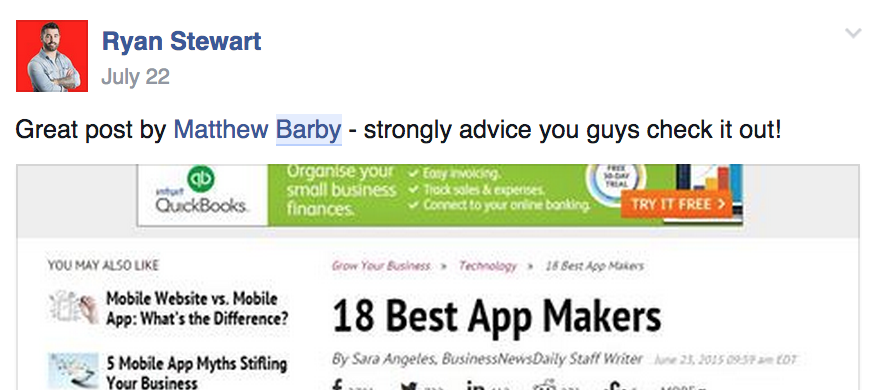
Tag them in the post so they know you shared it.

Screen Shot 2015-10-16 at 10.09.04 AM

They'll most likely join the Group on their own. This is a huge bonus for Group members and incentive for more to join.

Promote the Group on your site

You've got your Facebook Page on your website, right? Why not add (or replace) this with a link to your Facebook Group?

If your website does significant traffic, this is a great way to grow your Group.

Private Group Screenshot

Data shows the standard logos in the header attract little to no attention. Instead, I added a link to my Group in the bottom right-hand corner of my footer and tagged the link with a tracking CID.

Over 3 months, it drove 346 clicks. Not a massive amount, but every little bit helps.

Create "gated content" to entice people to join

It's not uncommon to create a great piece of content to entice email opt ins (aka "gated content"). Instead of asking for emails, you can drive people to your Facebook group.

For example, I wrote a post about how to create an SEO proposal. I also took the time to create a free proposal template for visitors to download for their own use.

Screen Shot 2015-11-13 at 11.36.06 PM

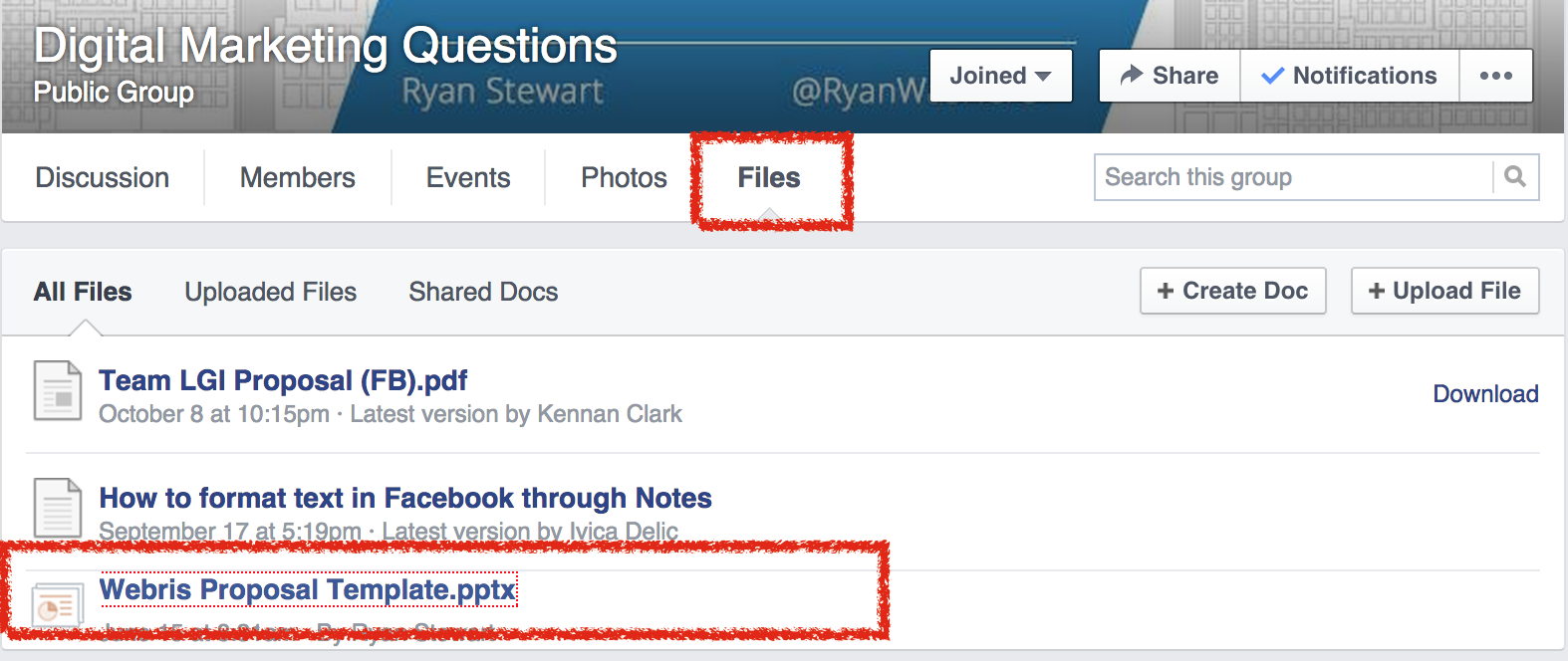
I hosted the proposal template within the "Files" section of the Group.

Screen Shot 2015-11-15 at 12.40.58 PM

To download it, they had to join the Group. Of course, just creating content isn't enough, we've got to promote it as well.

I chose to use organic channels like Inbound.org, GrowthHackers, Warrior Forum, and a few others.Screen Shot 2015-11-20 at 7.01.53 AM

This was by far the most effective method I used, not only to gain members, but quality ones as well. Try and focus your promotion efforts in places where your target users are spending their time.

We want to focus more on building a quality, engaged member base as opposed to a massive, inactive one.

Facebook Ads are extremely effective

It took me some tinkering to figure out how to promote the Group with Facebook Ads.

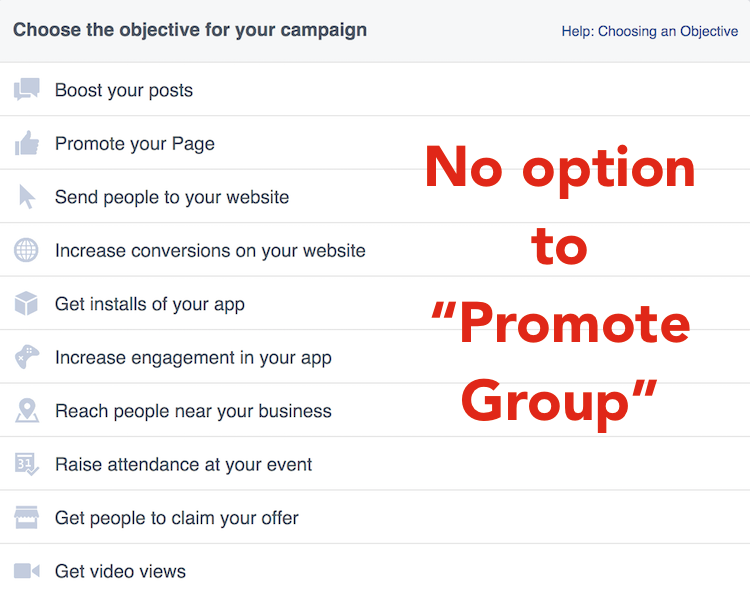
You can't promote a Facebook Group the way you can with a Page.

Screen Shot 2015-11-20 at 7.13.48 AM

Here's how to get around it:

  1. Write a post on your Facebook Page and drop a link to the Group
  2. Create a new Ad, select "Boost your posts"
  3. Select the post with a link to your Facebook Group

Screen Shot 2015-11-15 at 1.45.30 PM

I started by targeting by remarketing list and then expanding to lookalike audiences after that was exhausted.

In honor of full transparency, exact results from the ads are difficult to track.

"Results" are calculated by post engagements, i.e. Page likes, comments, shares, etc. Not included in "results" are people who clicked through and joined the Group.

Screen Shot 2015-11-15 at 1.25.07 PM

From my own calculations, the Group grew 300 members during the 1 week we were boosting the post — that's three times the organic growth rate.

Even though you can't directly track new members with analytics, Facebook ads are no doubt a valuable promotion tool.

Drive [indirect] traffic to it

I write a lot of guest posts. Within my posts I often link to my personal website.

Screen Shot 2015-10-16 at 10.19.46 AM

That site has a big ol' call to action to join the Facebook Group:

Screen Shot 2015-10-16 at 10.18.27 AM

This helps to strategically reach new audiences without directly promoting the group within the post.

You can also use guest posts to drive traffic to your post with "gated" content. Both tactics work well, but this one is slightly more direct.

Cross-promote with other Groups

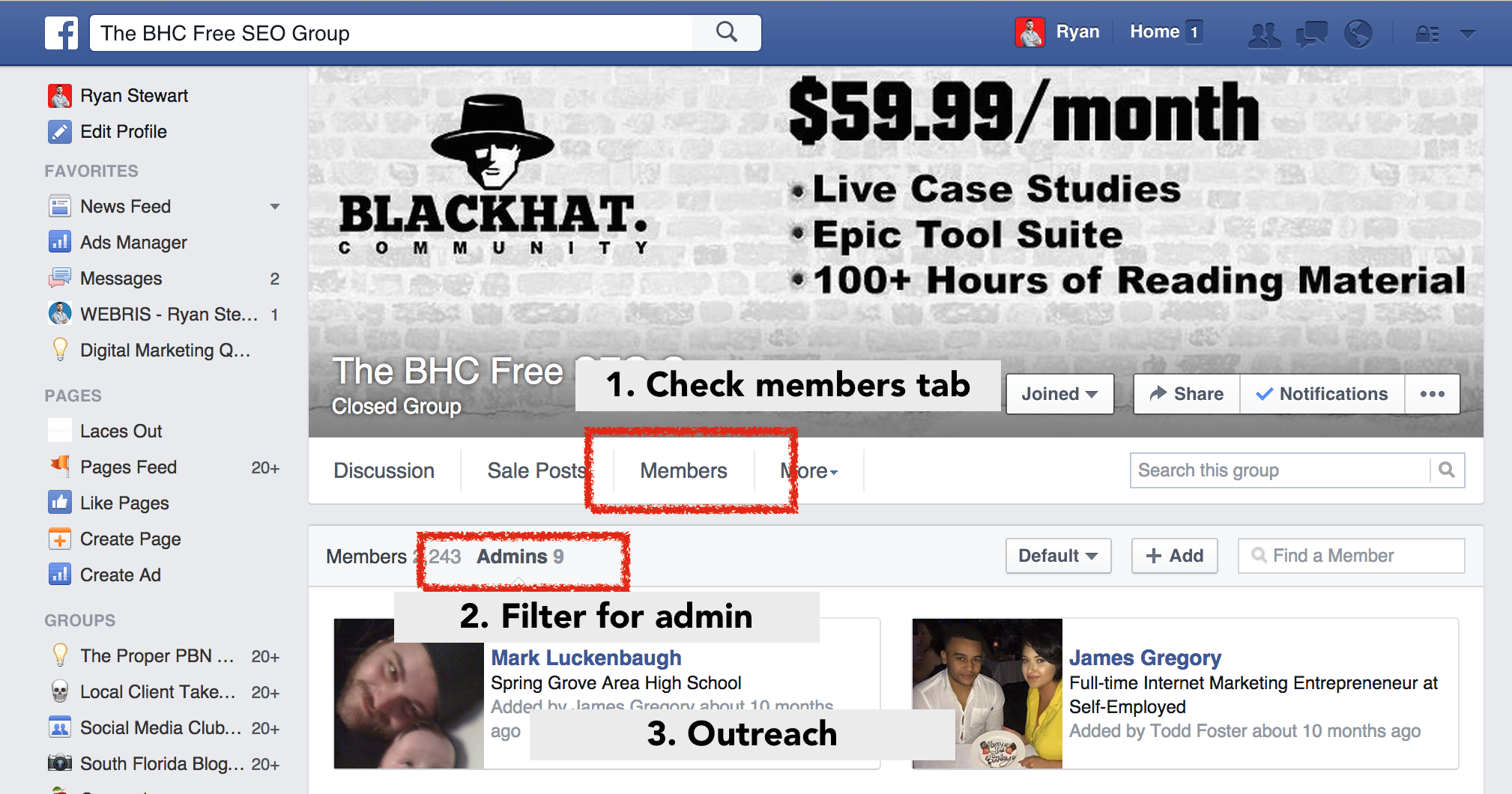
If you're consistently adding new members, you can pitch other Group admins to exchange cross promotion posts. I've had good success using Facebook's internal search to find similar groups.

Screen Shot 2015-11-15 at 12.46.47 PM

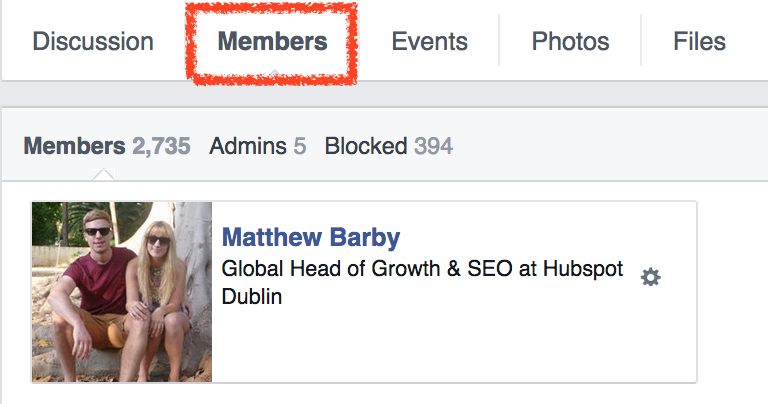
It takes a while to find spam-free Groups, but once you do it's just a matter of tracking down admins, adding them as friends, and sending them a quick pitch.

Screen Shot 2015-11-15 at 12.47.11 PM

If you've got a different audience base, you can add tremendous value to each other by exposing your Groups to new audiences.

Step 4 – Keep your Group spam-free

The biggest knock against Facebook Groups is spam. A Group can turn into a discount Ray Ban marketplace overnight if not carefully watched by the admins.

It's your job to set and enforce the rules.

It starts with a strong Group description

Leave no room for guessing. If someone joins the Group and immediately promotes a link, they're banned, no questions asked. It's entirely too much work to give individual warnings to people.

Screen Shot 2015-11-18 at 4.27.07 PM

Encourage Group members to flag spam if they see it — stand firm on your no spam rule.

Remind members of the rules from time to time

Some people are in a lot of Facebook groups. They don't always remember what they can or can't do in each group.

If you get an uptick in spam in your group, post a reminder about the rules. This has the added benefit of pulling the group together, since the members genuinely want a spam-free place for questions and discussion.

I got tired of repeatedly posted warnings so I created a video and pinned it to the top of the Group. Since doing that, we've seen a significant drop in spam posts.

Screen Shot 2015-11-18 at 11.42.48 AM

Handle rules infractions via PM

Even established members of the group will occasionally break the rules. Usually it's because they forgot or weren't sure if something was okay to promote.

In those cases, delete the post, but also PM the offending member and let them know what happened.

Often the person will apologize and that's all you'll need to do. If they argue with you, just remember it's your group, not theirs. You get to decide who stays and who goes.

Occasionally let people know when you ban someone

When you ban someone from the Group, it's an opportunity to reinforce the pride people feel at being part of the "inner circle."

They get to stay, because they followed the rules. The other people broke the rules, so they got banned.

This also reminds people to report spam or rules infractions when they see them.

Moderate disputes by PM

Sometimes a passionate discussion devolves into an ugly argument. When that happens, PM to the parties involved and let them know it's not okay to have a big public fight in the Group.

Usually that will calm things down. If things got really nasty, you also have the option to just delete the entire thread.

Consider getting a full-time moderator

Finally, when your group gets big and active, you might not have time to properly moderate it.

That's the time to hire a moderator. Often you can find someone who's already active in the group, knows the rules and is willing to do it for free.

Bottom line — a Facebook Group can turn to spam quickly. Make sure you're prepared to invest some resources to make sure it stays clean over time.

Conclusion

The numbers don't lie — my Facebook Group is the strongest brand asset I have.

If you're looking to build an active, engaged community around the problems your business solves, I strongly suggest you look into creating one of your own.


Sign up for The Moz Top 10, a semimonthly mailer updating you on the top ten hottest pieces of SEO news, tips, and rad links uncovered by the Moz team. Think of it as your exclusive digest of stuff you don't have time to hunt down but want to read!

Monday, 28 December 2015

Case Study: How Switching Tools Increased Email Reply Rates by 187% in 1 Month

Posted by kelseyreaves

The link building world is in a constant state of evolution. New tools are continually introduced to the market, with SEOs ready to discover what works best. Our outreach team at Modernize recently found ourselves in this position. In need of a new email automation service, we were eager to explore and test out new tools to see what improved our overall outreach system.

Modernize is in the home improvement space, and we focus heavily on energy efficiency and green living — thus, we target lots of green blogs, solar websites, etc. Our aim at Modernize is to be a resource for homeowners and provide quality content so homeowners can make informed decisions when it comes any home improvement project.

When faced with this task of changing our email automation service, we were pleasantly surprised to come across a more effective tool. This recent switch drastically increased response rates and ultimately our number of attainable back links. In an effort to help other link builders increase reply rates, I wanted to detail our process of switching from Get Response to Pitchbox, and how we eventually increased our response rate by 187% in only one month's time.

The original setup: Get Response and Infusionsoft

Our link building strategy has two main parts that work in conjunction to generate links: our initial outreach email sent via Get Response and our marketing automation built in Infusionsoft. Both parts are essential to our outreach strategy; however, with time we had realized Infusionsoft was working great, while Get Response was causing us some trouble.

To begin, we take the list of prospects we've assembled and upload them into Get Response. Next, we craft our initial outreach message using a Get Response template. Each email used similar messaging, although we swapped writing examples based on the vertical we sent to. For example, green websites would be sent samples of our content on “How to Save Energy at Home This Winter” and “Why Solar is Always a Good Investment.” Home decor bloggers were sent our sample content on “Trendspotting: Home Accents in Neon” and “Great Sources for Temporary Wallpaper.”

For each response, we’d create a record in Infusionsoft that contained their basic information, including their first name, the source, email, website name, Domain Authority, and Page Authority. We also place each contact within the appropriate status in the 10-point sales sequence we created.

Here's each step in that sequence:

  1. Not Interested: The contact isn't interested in having us contribute content.
  2. Interested: When an individual is interested in learning more about what we are doing. They may ask questions like “What's in it for me?”, “What is in it for you?”, “Do we have to pay for content?”, etc.
  3. Negotiation: When they're interested in hearing article topics. We usually pitch 2–3 article topics for them to choose from. We also leave the option open for them to suggest ideas to us.
  4. Article Requested: When we've agreed upon an article topic and it's now time for our content team to write the article.
  5. Article Sent: The article is completed and sent out to be reviewed.
  6. Scheduled: Article is scheduled to go live.
  7. Won: The article is published and live on their website.
  8. Paid: There's a fee for posting an article.
  9. Lost: If a contact had at one time expressed interest and was moved into the sales sequence, then changed their mind (ex. they did not like the article), we classify them as "lost." The biggest reason for moving a contact to lost is that we simply never received a response back, even after a series of follow-up messages.
  10. TTYL: When the individual is interested but would like to discuss at a later date.

modernize example photo2.JPG

Example contact in Infusionsoft

modernizeexample3.JPG

Example contact placed into marketing automation within Infusionsoft

We place each record created in Infusionsoft within our marketing automation. If a prospect doesn't respond within a week, they get an automated follow-up. The messaging varies dependent upon where they are in the sales sequence. Each stage has a series of 5 follow-up messages. If after 5 tries there's still no response, we move the contact to “Lost.”

Infuionsoft.JPG

Snapshot of 2 stages of our sales sequence built in Infusionsoft

Problems we experienced with Get Response

As we standardized the process, it was clear that Get Response had drawbacks. With Get Response, you’re required to use one of the pre-made templates when sending out a bulk email. We tried to make the template look as "real" as possible. However, the best template we found offered a cupcake-yellow background and unusual centering. As one would expect, our initial email looked very spammy. Furthermore, the “From: 332015@getresponse.com” at the top was a dead giveaway that the email was automated.

Original Message.JPG

With this process, you cannot set up automatic follow-ups to those who do not respond or open the initial email. It’s essentially a one-and-done deal. Therefore, if a prospect didn’t respond to our initial email, we would have to manually export the list, craft a follow up template, and send an entirely new message. Needless to say, this was not a viable option for the volume we were striving to reach on a weekly basis.

Why we made the switch

When making the switch from Get Response, we had certain features we were in need of that the new tool we tried, Pitchbox, was able to fulfill. These included:

  • Follow-up messaging: After the initial email is sent, we wanted the ability to create two unique follow-up messages for those that that do not open the first email, second email, and so on.
  • Lots of personalization: The ability to personalize each email with website name, first name, etc. Pitchbox syncs each website with their Facebook and Twitter, giving us the option to quickly access their social media if we feel the need to mention their latest article or social media post within the outreach message.
  • Synced with Gmail: Our message will be sent through our own Gmail accounts; therefore, it's a real email that doesn't come off spammy.

Pitchbox2.JPG

Pitchbox templates, including the initial message and two follow-up messages

Setting up Pitchbox

Our first step when setting up Pitchbox was to connect our outreach email to the account. After we synced our account, we crafted the first outreach message. Minus a few changes in wording, we essentially used the same message in Pitchbox as we had used with Get Response. The pitch read:

secondmessage2.JPG

Over time, we tested different subject lines and discovered our highest-performing subject line was “quick question about: domain.com” that had an average open rate of 60.19% across all verticals.

Next, we went ahead and created the follow-up messages. We wanted the follow-up messages to look as realistic as possible, and therefore used the following message as our first follow-up. The idea was to make it seem like we were replying to the last message we sent them.

Here's what the follow-up message looked like:

secondmessage3.JPG

The last follow-up message followed in the exact same form:

secondmessage4.JPG

We decided the optimal wait time between follow-up messages was 4 days. This gave us time both to respond to all emails and to follow up close enough to convey a sense of urgency.

Our next step was composing the outreach schedule. Pitchbox sends one email out every 3–4 minutes; with multiple campaigns running at once, it was essential to create an outreach schedule that could handle a large volume of emails. Therefore, our outreach schedule sends out emails every day of the week, 7am until 8pm specific to the recipient's time zone. We also added another outreach email that helps to split up the volume of the emails.

Now we could send out two emails every 3-4 minutes, not just one. With Get Response, we did have the ability to send out emails all at once, therefore we could test different times of the day to see what works best. Since Pitchbox sends via Gmail, we don’t have the luxury of testing different send times.

Tracking our emails with Bananatag

Pitchbox provides you with awesome analytics, specifically related to response rates. It can differentiate between the different replies, such as an out-of-office response versus an actual response back. It also looks at the opportunity age and accounts for the amount of responses over time. Get Response didn't have analytics on responses, but it did have analytics on opens and clicks, which Pitchbox does not currently have (though it's a feature they're adding in the future). Our weekly reporting focused heavily on response rates as well as open rates, so we needed to find a solution that would track the open rate and click rate of our outreach emails.

After researching our options, we discovered the email tracking service Bananatag. With this tool, every email sent through Pitchbox is given a tag that tracks the interaction.

pitchboxgraph.JPG

Individually-tracked emails found in Bananatag

For reporting, I’d simply export all tags and do a VLookup in Excel to compare email lists sent with the tags Bananatag has tracked. From there, I’m able to find the open rate and click rate for each campaign.

The hard numbers speak volumes

It's clear in this case; the numbers tell the story. When we were using Get Response as our email automation service, our average reply rate was 16.55%. The accept rate of an individual expressing their desire for an article was 5.32%. When we made the switch from Get Response to Pitchbox, our average reply rate increased by over 187% to 47.44%. The accept rate increased as well: it's at 7.35% and continues to steadily increase over time.

We also saw a positive increase in open rates of the initial outreach email. With Get Response, the average open rate was 49.59%. With Pitchbox, the average open rate is now 54.76%.

Reasons for the overall increase in performance?

It’s safe to say the switch in email automation service was the reason for the overall increase in response rates and accept rates. We hypothesized that the main reason for the overall increase was the legitimacy of the initial email. Because it's sent through gmail, therefore looks like (and is) a genuine email. There aren't any weird alignment issues or off-colored backgrounds — just a good, ol'-fashioned email that looks as if I crafted each one individually. The follow-up messages are also another big reason for our increased reply rates. With Pitchbox, we increase our chances of getting a response with the three message we send, unlike the one chance we got with Get Response.

How could the process be improved?

Moving forward, we really want to test different types of messaging, specifically related to the follow-up messaging and the outreach schedule. Currently, the two follow-up messages we use in our campaign are sent out every 4 days. We'd like to test this and see if we should narrow that time from 4 days to 2, or possibly extend the time in between follow-ups from 4 days to 7. Testing our messaging is also vital to improving the process. Are prospects losing interest too quickly because our message is too long? We plan on A/B testing this in the future, using our original message and a shortened version.

In conclusion

When faced with the task of changing our email automation service, we were pleasantly surprised to have not only improved upon the tools we use in our link building process, but ultimately increase our reply rates drastically — by 187%. Have you had your own success with any particular outreach tools? Share your tips in the comments!


Sign up for The Moz Top 10, a semimonthly mailer updating you on the top ten hottest pieces of SEO news, tips, and rad links uncovered by the Moz team. Think of it as your exclusive digest of stuff you don't have time to hunt down but want to read!

SearchCap: Santa, Google NCR & SEO Success

Below is what happened in search today, as reported on Search Engine Land and from other places across the web. The post SearchCap: Santa, Google NCR & SEO Success appeared first on Search Engine Land.

Please visit Search Engine Land for the full article.

Make your own games with the Unity 5 Game Hacker Bundle

shutterstock_289434728
The only way to gain true game-hacking knowledge is through hands-on learning, and Unity’s 5 Game Hacker Bundle provides the perfect platform, with games you’ll be creating as you learn how to code them. Unity3D is one of the most popular engines to use, since it can make games for just about any platform, and also allows for easy porting from one to another. At 89 percent off on TNW Deals, learning to code your own games has never been more comprehensive or affordable. This five-course collection offers over 30 hours of content to work your way through, teaching you…

This story continues at The Next Web

Join the Copyblogger Team for Our First Content Challenge

Challenge begins January 4, 2016 - build your website's content marketing cornerstone

Starting a week from today, the Copyblogger team is doing something we’ve never done before … and we want you to join us.

We’re hosting our first three-week Copyblogger Content Challenge. These brand-new challenges are designed to give you in-depth education around key content marketing topics.

The goal of our challenges is simple:

We help you master each topic — and you put that information directly to use to grow your business.

Challenge #1: Create your cornerstone content

For the January 2016 challenge, we’re teaching you how to create powerful, audience-building cornerstone content for your website.

The three recent articles below will help you understand what cornerstone content is and why it’s important to have it in place on your site.

How much does this in-depth cornerstone content education cost? Nothing. :-)

Join us for the Copyblogger Content Challenge

Why is cornerstone content important?

Website owners use cornerstone content to answer the most important questions their newest prospects have.

Cornerstone content pages are informative, instructive, and they help your prospects understand the crucial information they need to interact with your business.

Once you have your cornerstone content in place on your website, you’ll begin benefitting from better search engine rankings for the terms you target. And cornerstone content builds your authority, too.

Here’s what you get when you join us for the Copyblogger Content Challenge:

  • In-depth instruction on planning, writing, and creating cornerstone content pages
  • Support and encouragement from the Copyblogger team: Sonia Simone, Pamela Wilson, Stefanie Flaxman, and Demian Farnworth
  • Community support from your fellow challenge members in our temporary “pop-up” forum
  • A live educational webinar about cornerstone content — exclusive to our challenge participants

As we mentioned above, there’s absolutely no cost to join us for this challenge. We only ask that you commit to devoting a little time each day to working through the materials.

Our promise is to keep things fun and easy, so you make fast progress and enjoy the process.

We’d love to help you set up your cornerstone content and sail into 2016 with a powerful, content-driven website!

Join us for the Copyblogger Content Challenge

Remember, there’s no charge. Register to get started! We’re looking forward to having you in January’s Copyblogger Content Challenge.

About the author

Pamela Wilson


Pamela Wilson is Executive Vice President of Educational Content at Rainmaker Digital. Follow her on Twitter, and find more from her at BigBrandSystem.com.

The post Join the Copyblogger Team for Our First Content Challenge appeared first on Copyblogger.