Thursday, 2 June 2016

The social network landscape [#ChartoftheDay]

Facebook is dominating the social media landscape. But by how much?


The average Smartphone user spends in excess of 2 hours a day looking at their screens, either texting, browsing the internet, scrolling through emails and more often than not using apps.


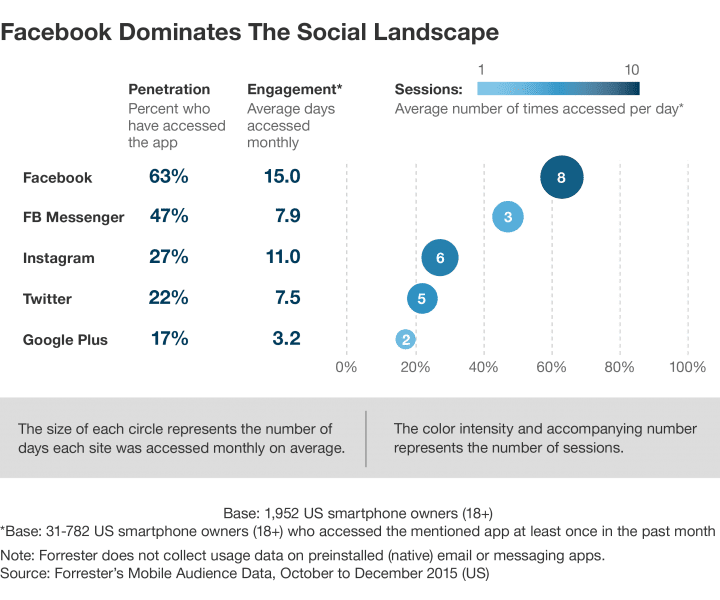
Now it's the use of apps in particular which is the focus of this article, more specifically around social networks. The below chart compares the reach of social media, as well as the average number of days per month and the sessions per day.


The Social Media Landscape


One of the most pertinent takeaways from the Forresters Report, is just how "addictive:" Facebook is. The chart breaks down the amount of touch points or "session" we have with the apps throughout the day. Facebook leads the way with on average 8 sessions, per day used. Followed by Instagram with 6 and Twitter with 5. This highlights the constant need for communication and content, we need everyday.


This chart, once again, highlights the dominance Facebook has over their competition, with a penetration rate of 63%, a whole 35% higher than the next closest competitor Instagram. Twitter performs favourably too, with a 22% penetration rate, however it is somewhat overshadowed by Facebook's dominance.


Facebook are again out in front in terms of Engagement, on average being accessed around one day out of every two. Instagram aren't far behind, as it is being accessed on average one day out of every three.


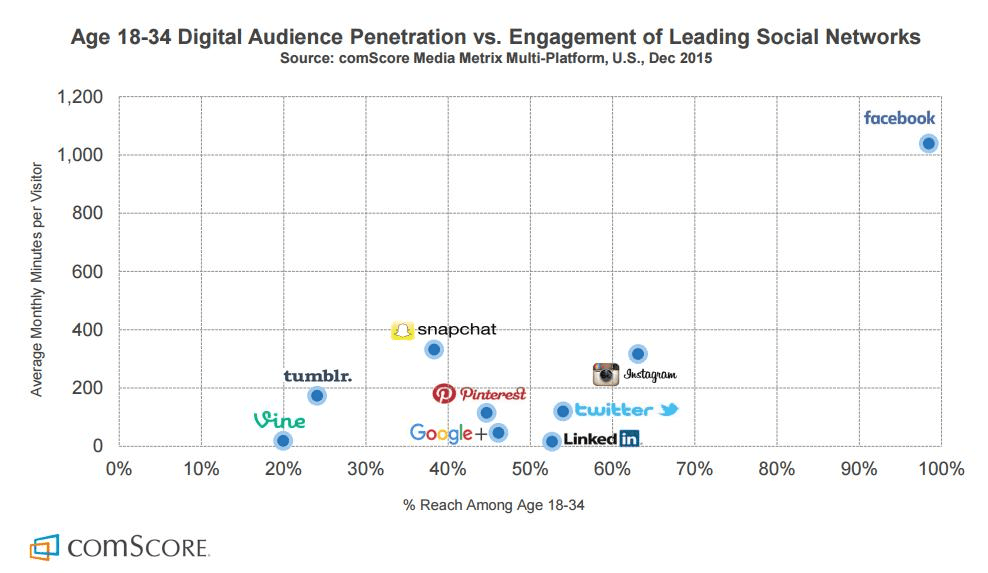
The below chart delves into the penetration vs engagement situation, with a little more detail. If you want to do some further reading on the matter, ComScore recently published their US Cross-Platform Future in Focus


Digital Audience Penetration vs Engagement of Leading Social Networks


* Forrester's mobile audience data helps you understand how your customers behave in their mobile moments - and if you play any role at all. It will give you a better understanding of your target consumers and how they use their mobiles and tablets, from the amount of time they spend on different social media outlets to their most popular time of day to visit shopping websites. We track behavior using a passive application on consumers' smartphones and tablets that allows us to subtly collect data without disrupting normal behavior. Compared with other data sources, it allows us to capture actions at a very detailed level with precision, eliminating measurement errors by analyzing usage of what consumers do, not what they say they do

If you're keen to find out more details about social media, have a look at our social media statistics post for similar information.


Marketing Automation Defined in 60 Seconds [Animated Video]

content marketing glossary - what is marketing automation?


Ever find yourself in a conversation with your boss or a client and she mentions implementing marketing automation?


Did you understand her request, or did the conversation grind to a halt because you're not familiar with the term?


If you fall into the second category, you're not alone.


Marketing automation is a hot topic these days, and its popularity has grown rapidly since 2013, but it can be tricky to define.


What exactly is marketing automation?


Watch our 60-second video about marketing automation


With help from our friends at The Draw Shop, we whipped up 12 definitions from our new Content Marketing Glossary into short, fun whiteboard animated videos.


Here's our video for the definition of marketing automation:


Animation by The Draw Shop


And for those of you who would prefer to read, here's the transcript:


Marketing automation refers to software used by people and companies to streamline, automate, and measure marketing workflows by automating repetitive marketing tasks.


In other words, it performs certain manual marketing tasks for you. Night and day. Rain or shine.


Here's an example of how it works:


Imagine someone downloads one of your ebooks. Marketing automation software will capture the contact information from the form, segment that lead based upon the information it gathered, and then send them an appropriate series of emails over a prescribed time.


Share this video


Click here to check out this definition on YouTube and share it with your audience. You'll also find 11 additional Content Marketing Glossary videos.


Learn more from the Content Marketing Glossary


We'll feature the rest of the videos soon, but if you'd prefer not to wait, you can watch all the videos now by going directly to the Content Marketing Glossary.


If you would like to learn more about marketing automation, visit these three resources:


By the way, let us know if there are any definitions you'd like us to add to the glossary! Just drop your responses in the comments below.


The post Marketing Automation Defined in 60 Seconds [Animated Video] appeared first on Copyblogger.


Wednesday, 1 June 2016

An anonymous millennial known only as


God created the world in six days, rested the seventh and on the eight he discovered emoji. Fast forward about 6,000 years (if you're a Christian), or 4.5 billion years (if you're not) and God's supposed word has just been translated into the language of the millennial - emoji. There were something that happened between the first thing and the last thing, but let's not get too caught up in the details. Jumping ahead again, a devout millennial Christian just created an application for iOS called 'Bible Emoji: Scripture 4 Millenials,' that features all 66 books of the King James…

This story continues at The Next Web


Complaints Here, There and Everywhere – A Series About Complaints at GetFiveStars.com

I have just published my first of a number of articles (I am at 4 and counting) dealing with the question of customer complaints:  5 Good Things About Customer Complaints. These articles will cover ideas, processes and research to help you understand the whys and wherefores of complaints and how their successful resolution can really … Continue reading Complaints Here, There and Everywhere – A Series About Complaints at GetFiveStars.com


What you can learn from three brands that went viral

There's no magic formula for going viral, but there are ways to boost your chances.


You've heard the success stories: A brand creates content that takes off unexpectedly and elevates its reach and influence dramatically.


So how do you make it happen for yourself? There's not a magic formula, but there are steps marketers can take to increase the chances of virality.


My team at Alexa analyzed a series of websites that had posts take off like wildfire. We chose the sites we did because the publish date for the viral posts directly corresponded to a rise in the hosting site's traffic numbers. We used Alexa's competitive intelligence tool to analyze each website's traffic, global rank, and reach.


Analysis of Mic.com


Amy Poehler – described by one journalist as a media darling and all-around-awesome lady – is something of a feminist icon. It's no surprise that millennials are enamored with the actress, which is why Mic.com's article with quotes from the celebrity likely did so well.


Mic shared a listicle (a short-form article with a bulleted or numbered list) with more than a dozen relationship quotes from Poehler. There's an empowering theme throughout the article with tidbits like, “You deserve love and you'll get it.” The piece didn't garner many shares on Twitter or LinkedIn, but it was shared on Facebook more than 7,600 times.


viral analysis


After the article was published, Mic's global rank increased 22 percent and its reach nearly tripled.


Mic is a website geared toward millennials and young adults – the website's mission statement says “young people will define the future and we deserve a news outlet that offers quality coverage tailored to us.” The listicle was easy to digest and easily shareable, which made it a hit with Mic's audience. The site's audience is primarily women between the ages of 18 and 44, and 82 percent of its traffic comes from social media.


So what can other marketers learn from Mic's success? A catchy and compelling headline can get the attention of social media users. Pop culture references and universally popular topics are a simple way to drum up web traffic – it's hard to go wrong with relatable relationship tips from a well-liked star.


Analysis of Creativity-Online.com


Texting while driving kills thousands of people every year, but one-third of drivers admit to being distracted by their phones while on the road. AT&T released an advertisement about the consequences of texting while behind the wheel as part of its “It Can Wait” campaign. The film shows how many lives are changed after a devastating accident caused by a woman checking social media while driving. The crash is jarring and hard to watch, but the message resonates with viewers. The agency who created the ad sought to make it “raw and emotional,” and it works.


It got millions of views on YouTube and was reposted by Creativity-Online.com, a website that “highlights the best in idea-centric communication, advertising, design, websites, and interactive ideas.” Over the next couple of months, the site's global ranking increased 29 percent. Three days after it went live, the site's reach skyrocketed sevenfold and page views increased eightfold.


viral analysis


Interestingly enough, Creativity-Online has pretty even sources of traffic. Thirty-five percent of people visit the website directly, while 32 percent find it through search. Only 23 percent of traffic is from social media.


What made this post so successful? The video is almost four minutes long, which can be a risky move when audiences often have short attention spans. But utilizing an element of surprise will keep people watching and grab your audience's attention. Additionally, texting while driving is a social issue that many are passionate about.


Analysis of HoustonPress.com


Leonardo da Vinci once said, “The greatest deception men suffer is from their own opinions.”


It's likely Jeff Rouner would agree with him. Rouner authored an opinion piece for HoustonPress.com, a Houston-based entertainment source. In “No, It's Not Your Opinion. You're Just Wrong,” he argues that it's important to challenge our beliefs and opinions. Rouner's piece is strongly worded and sarcastic, but it was popular among its readers. The article was shared more than 36,000 times on Facebook.


HoustonPress.com originally published the piece on July 23, 2015, and over the subsequent months, the website's global ranking shot up 32 percent. Rouner manages to be controversial without being isolating – two days after the article was published, the site's reach increased fivefold while page views nearly quadrupled.


viral analysis


The site's traffic is predominately search-oriented: Nearly half of online users find it via search, nearly 23 percent visit via social media, and just over 20 percent visit the site directly. It's most popular among college-educated women between 35 and 44 years old.


After the article was published, Rouner appended a correction about some of the information he shared and said, “My opinion was based on bad data. Now it's not.” He's fallible and not afraid to admit it, which makes his piece even more appealing.


What's the takeaway here? You never want to alienate potential readers or viewers, but it's possible to be polarizing without being offensive. Additionally, offering new information will always attract audiences – people aren't interesting in hearing about things they already know.


One of the most important things we learned is the value of knowing your audience. The Poehler listicle wouldn't have done as well on a site with an older demographic interested in serious content, and the AT&T film likely wouldn't have taken off if it wasn't targeted toward people interested in creative advertisements. Using website analytics to track audience demographics and sources of traffic can help determine what content will work best for your brand.


So, let's talk about this song a Google Brain machine composed


Researchers have been attempting to make robots and artificial intelligence more creative over the past months – from drawing to writing quasi-dystopian poetry. Today we get another piece of work from a Google machine: a 90-second melody. It's the result of Google's Project Magenta, which aims to use machine learning to create music and art, and bridge the communities between those interests with coders and researchers. Magenta is built on top of its TensorFlow system, and you can find the open-sourced materials through its Github. The team says the challenge is not to just get Google machines to create art,…

This story continues at The Next Web


Tuesday, 31 May 2016

The 10 commandments of Growth Hacking

How to use Growth Hacking to get real results


The growth hacking approach (also referred to as 'agile marketing' and 'growth marketing') has generated a lot of excitement as a dynamic approach to boost awareness, lead generation and conversion.


Sean Ellis, a marketer and entrepreneur who has worked for companies such as Dropbox and Eventbrite, devised the term 'Growth Hacking' in 2010. Originating from Silicon Valley, growth hacking has successfully been used to build high-growth companies such as Hotmail, PayPal, Twitter, Airbnb, Instagram and Uber. Ellis says:


“Startups live and die by their ability to drive customer acquisition growth…[they] are under extreme resource constraints and need to figure out how to break through the noise to let their target customers know they have a superior solution for a critical problem…the best growth hacks take advantage of the unique opportunities available in a connected world where digital experiences can spread rapidly.


Growth hacking is now gaining traction in the UK and has recently been termed 'the next big thing for marketing' by Advertising Age. Even well-established organisations such as The Guardian have recently advertised related job roles, such as 'Head of Growth Hacking', which has further raised its profile.


Although the term 'hacking' has technology connotations, more traditional companies such as Regus and Penguin Books are also using the principles of growth hacking. This indicates that the concept is not just relevant to technology start-ups and this movement has wider implications. Think of it as 'marketing digital disruption' because technology is an enabler for marketers to understand and respond to user behaviour more rapidly.


Core Principles of Growth Hacking


The core principle behind growth hacking is to quickly and cheaply test a marketing idea, use data to analyse the outcomes, and to iterate, optimise, implement or change the experiment. Running A/B tests and checking data with analytical software such as Google Analytics, Mixpanel and Optimizely are essential components to this process.


Despite the high data analysis element of growth hacking, it is an extremely creative process that requires people to “swim against the flow” and spot emerging opportunities before anyone else does. This dichotomy of 'intuition and rigor' and 'art and science' makes it very difficult to find people with the right skill-set; which is why building a growth hacking team is so important (or finding an agency with this type of team already in place).


Although digital marketing is a key element of growth hacking (because of the analytical part of obtaining quantitative user data and gaining insights from it), it is also important to use traditional marketing methods to bridge the gap between the physical and digital world. 


Creating a Growth Hacking Mindset


Growth hacking is an approach, rather than a set of tools.


To illustrate this, we are going to tell you about a brilliant growth hack that has nothing to do with either marketing or business. Instead, it tells the story of a winning mind-set…


In 1996 Britain's cycling team was ranked 17th in the world and had won just 2 bronze medals at the Atlanta Olympic Games. By 2012 they ranked first in the World and British riders had won 12 medals (8 gold) at the London Olympic Games.


cycling aggregate gains


Its success was largely down to the coaching of Sir David Brailsford. His approach was to breakdown everything that went into riding a bike and improve it by 1%. Putting all of the 1% margins together meant that in 2012 British Team Sky had won 70% of the gold medals in cycling at the Olympics.


There wasn't a magic silver bullet but a series of micro, cost effective and human-centred optimisations that could be effectively scaled. This demonstrates what a growth hacking mind set looks like.


To be a good growth hacker:


  • Mindset is extremely important – growth hackers focus on accelerated growth on a minimum budget. It's all about users (or an alternative KPI, depending on your business)

  • Being curious and creative are key elements. Don't get fixated on spending a particular budget, go back to basics and think about tapping into human behaviour (we're social animals)

  • The internal culture is important: the business needs to be open to experimentation – some ideas will fail

  • It needs a good (Pi-shaped) team, i.e. marketers with a broad base of knowledge in all areas, but capabilities in both 'left brain' and 'right brain' disciplines. They are both analytical and data-driven, yet understand brands, storytelling and experiential marketing


The team element is very important as one individual person is unlikely to have all of the skills needed for growth-focused marketing.


The 10 Commandments


1. Talk to your customers, identify trends, understand why they need your product or service


  • Magic bullets rarely exist; if you spend too long looking for them you'll take your eye off the ball. Focus on the things that matter – serve amazing customer experiences (like Zappos) and product value (like Instagram and Skype)


 2. Understand the landscape you are operating in


  • Some products or services are never going to achieve viral growth because of what they are and the market the company operates in

  • Try to predict the future needs of your customer – be one step ahead of them. Never fall behind or your competition will get there first. Think about how Instagram offered a more superior photo sharing app than Facebook.


3. Develop the unique rules of growth for your particular organisation


  • What are your company's growth metrics or KPIs?

  • What's the one metric you need to move, to get to the next stage?

  • Be growth focused and use data to make sure you are on track

  • Be technical and have a strong market focus


4. Make extensive use of pilots and prototypes


  • Build fast, test fast. Start with a Minimum Viable Product (MVP) and talk to users about it

  • Does your product serve a real need? Be honest!


5. Experiment early and often for aggregated marginal gains


  • Don't look for a silver bullet, test lots of small things

  • Rather than having one web page have a series of web pages and work out which one converts the best


research XL framework


The ResearchXL framework has been produced by Peep Laja. Visit his blog to find out more about each area of the framework.


The information gained from this type of analysis can then be used to test hypotheses' relating to user growth and validate ideas. This process is essential to finding 'non-norm' solutions to achieve growth in a short amount of time.


6. Focus on asking the right questions


  • What's going to make the biggest difference to your business? Working out how to get there

  • Don't think online or offline. Think: Who am I talking to?

  • What am I trying to achieve? What is the best way to get there?


7. Use behavioural quantitative market research and to sharpen selection


This approach is basically using structured testing to improve website effectiveness. Growth optimisation is moving from data, to insight, and then to money. User data analysis is needed throughout this CRO process, so that activity can be prioritised.


  • Constantly A/B test – you can only hack something once you start testing an idea and find out what actually works

  • Analysis has to be spot on. But there's a difference between analysis and insight, growth hackers understand the difference

  • You need to be able to take apart a top-level number…'We had ten million visits today. X of them were in this category and did this and Y were in that category, they might have done that.'


behavioural marketing


Generally, a company should use a minimum sample size of 250 to test changes for CRO. You also need to think about business cycles - e.g. if your weekend traffic is very different, ending a test by excluding that segment would make your sample unrepresentative.


8. Use qualitative research to improve intuition


  • People buy brands and emotion and this is needed whatever your business is, whatever you are working on. Growth hacking isn't just a scientific numbers game.

  • Qualitative research is very important. It's about understanding the 'why' and provides you with more of a 3D focus on exactly why things happen.

  • Use qualitative data to find out: What are our users interested in? What else are they looking for? What's their experience like? The numbers many be going up but if people are really irritated by something you've pitched to them, you won't be able to capture them again like you did in the beginning.


9. Clearly define and communicate new offers


  • Run numerous tests but have a plan for the sort of things that the hypotheses should be, they should be documented somewhere in an Excel file. Track the results. You should re-run the experiments; never assume that if you're doing them in January, the results will be the same in June…products have seasonal customers.

  • There's never perfect data but there's a lot more data in the digital space than the offline world. You can serve messages to different people through testing tools like Optimizely and check analytics on email, social media, etc. which allow you to instantaneous get feedback and adapt your approach accordingly.


10. Encourage a culture of creativity and experimentation across teams


  • You can't growth hack without the right team. They need to understand what growth hacking is. If they don't understand it, they're going to struggle. And you're all going to be doing a lot more fighting and arguing internally, and you won't get anything done.

  • If you're running experiments, or doing things that cause problems for other teams (which they can), you need to be able to negotiate and work them out. You can't just be in a silo.


Operational Elements of Growth Hacking


There are a few essential elements needed to be an effective growth hacker – these can be seen in the diagram below.


operational elements of growth hacking


Pirate Metrics


Investor Dave McClure of 500 Hats has often spoken about the marketing funnel and start up metrics for Pirates (AAARR). This is a useful tool for all types of organisation.


pirate metrics funnel